
Plastic Mold Insert
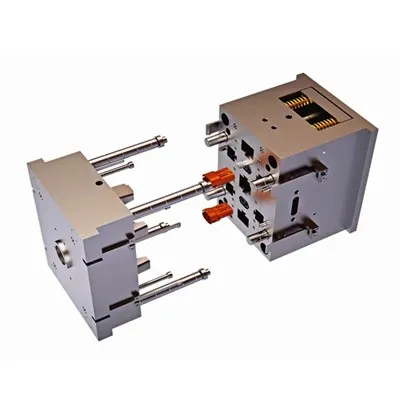
Stack mold is a cutting-edge technique in today's plastic mold creation. The cavity is dispersed on two or more layers and is overlaid, which is similar to assembling numerous pairs of molds.
- Fast Delievery
- Quality Assurance
- 24/7 Customer Service
Product Introduction
1.How is stack mold defined?
Stack mold is a cutting-edge technique in today's plastic mold creation. The cavity is dispersed on two or more layers and is overlaid, which is similar to assembling numerous pairs of molds.
2.The historical context of the lamination mold's need Typically, when an injection machine utilizes a single-layer plastic injection mold, the injection volume and mold opening process are only 20% to 40% of the prescribed amount, which limits the injection machine's performance, and the lamination injection mold cannot enhance the clamping force. With a single injection machine and operator, the output may be multiplied depending on the number of layers, significantly increasing production efficiency and equipment utilization rate while lowering production costs and human resource requirements. The stack injection mold is ideal for manufacturing big flat components, shallow cavity shell components, compact multi-cavity thin-wall components, and mass production components.
3. What are the benefits of using stack molds?
(1) When compared to traditional molds, the stack mold locking force is raised by 10% to 15%, while the output may be enhanced by 90% to 95%;
(2) the mold production requirements are almost identical to those for traditional molds, and the combination of several cavities in a mold significantly reduces the mold manufacturing cycle;
(3) Without investing in extra gear and equipment, a high-efficiency stack injection mold may double or triple the production of a conventional single-layer mold. This eliminates the need to invest in gear and equipment, expand the facility, and hire more employees;
(4) While the stack mold meets the same standards as the single-layer mold, the production efficiency per unit time is doubled.
(5) Reduce raw material costs, facilitate automation, enhance product performance, and reduce production cycles