

What Are Injection Machines
An injection molding machine, also known as an injection press, is a machine for manufacturing plastic products by the injection molding process. It consists of two main parts, an injection unit and a clamping unit. Injection molding machine molds can be fastened in either a horizontal or vertical position. Most machines are horizontally oriented, but vertical machines are used in some niche applications such as insert molding, allowing the machine to take advantage of gravity. Some vertical machines also do not require the mold to be fastened. There are many ways to fasten the tools to the platens, the most common are manual clamps (both halves are bolted to the platens); however, hydraulic clamps (chocks are used to hold the tool in place) and magnetic clamps are also used. The magnetic and hydraulic clamps are used where fast tool changes are required.
Advantages of Injection Machines
Impeccable Precision
Because of the way that material is injected to and then shaped by the mold, the number of imperfections can be reduced to a minimum. That means that with every run, you can produce a part that is identical to the one preceding it, over and over again.
Complex Details
Injection molding enables companies to produce even the most complicated mold designs, executing even the smallest of details with ease. You can add multiple details to your mold design and rest assured that each of them will be made a reality by the mold.
Durability
Unlike most other production methods, injection molding provides advanced possibilities in terms of the durability and reliability of the plastic parts that are produced. For instance, you can add fillers in the injection molds that are created, which can help reduce the density of the plastic material and make each part stronger.
Automation
One of the primary reasons why injection molding produces consistent results is that a lot of the actual manufacturing process can be automated. That means that you can not only reduce the chances of human error to a minimum, but also have the machine produce parts at a consistent rate and a high fulfillment rate.
-
![Compression Molds Injection Machines]()
Compression Molds Injection Machines
Add to Inquiry -
![Precision Tooling Injection Machines]()
Precision Tooling Injection Machines
Add to Inquiry -
![DSI Technology Molds Injection Machines]()
DSI Technology Molds Injection Machines
Add to Inquiry -
![IML Molds Tooling]() Add to Inquiry
Add to Inquiry -
![Cube Molds Injection Machines]() Add to Inquiry
Add to Inquiry -
![2K and 3K Molds Injection Machines]()
2K and 3K Molds Injection Machines
Add to Inquiry -
![Stack Mold or T Molds Injection Machines]()
Stack Mold or T Molds Injection Machines
Add to Inquiry -
![Baby Molds Injection Machines]() Add to Inquiry
Add to Inquiry -
![Silicon Rubber Mold Injection Machines]()
Silicon Rubber Mold Injection Machines
Add to Inquiry


Why Choose Us
Our Factory
The company was established in 2010 and grown up to a medium mold making company with 95 employees and a 4500 square meters tool building shop .The average mold design and building experience of our designer and mold maker isover 10 years.
Our Product
Automotive interior and exterior trim, medical mold, home plastic, cosmetic mold, compression mold, Product Application, Injection mold & molding, Overmold & 2K Mold, IML Molds(In-Mold Label), Cube Molds, Stack Mold (T Molds), Insert Tooling, Rubber/ Slicon mould, Compression molds baby plastic molds.
Our Service
We provide excellent solutions for various industries, and taking innovation, expertise and quality control as the backbone of our business core and provide our customers with a comprehensive end-to-end service for any product, engineering or manufacturing need.
Our Certificate
GB/ T9001:2016,ISO 9001:2015, ISO9001.
Hydraulic
Hydraulic machines have historically been the only option available to molders until introduced the first all-electric injection molding machine .Hydraulic machines, although not nearly as precise, are the predominant type in most of the world.
Mechanical
Mechanical type machines use the toggle system for building up tonnage on the clamps of the machine. Tonnage is required on all machines so that the clamps of the machine do not open due to the injection pressure. If the mold partially opens up, it will create flashing in the plastic product.
Electric
The electric press, also known as Electric Machine Technology (EMT), reduces operation costs by cutting energy consumption and also addresses some of the environmental concerns surrounding the hydraulic press. Electric presses have been shown to be quieter, faster, and have a higher accuracy, however the machines are more expensive. Hybrid injection (sometimes referred to as "Servo-Hydraulic") molding machines claim to take advantage of the best features of both hydraulic and electric systems, but in actuality use almost the same amount of electricity to operate as an electric injection molding machine depending on the manufacturer. A robotic arm is often used to remove the molded components; either by side or top entry, but it is more common for parts to drop out of the mold, through a chute and into a container.

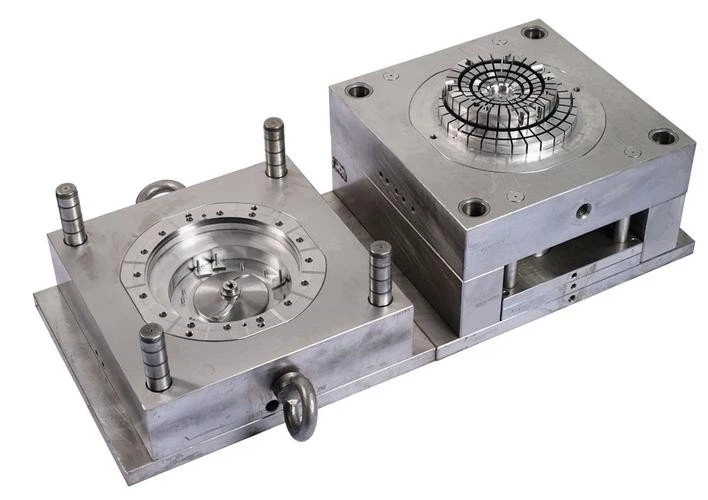
The first stage of injection moulding is to create the mould itself. Most moulds are made from metal, usually aluminium or steel, and precision machined to match the features of the product they are to produce.
Once the mould has been created by the mould-maker, the material for the part is fed into a heated barrel and mixed using a helical shaped screw. Heating bands melt the material in the barrel and the molten metal or molten plastic material is then fed into the mould cavity where it cools and hardens, matching the shape of the mould.The cooling time can be reduced through the use of cooling lines that circulate water or oil from an external temperature controller. Mould tools are mounted on plate moulds (or ‘platens’), which open once the material has solidified so that ejector pins can eject the part from the mould. Separate materials can be combined in one part in a type of injection moulding called a two-shot mould. This technique can be used to add a soft touch to plastic products, add colours to a part or produce items with different performance characteristics.
Moulds can be made of single or multiple cavities. Multiple cavity moulds can have identical parts in each cavity or can be unique to create parts of different geometries. Aluminium moulds are not best suited to high volume production or parts with narrow dimensional tolerances since they have inferior mechanical properties and can be prone to wear, deformation and damage due to the injection and clamping forces. While steel moulds are more durable they are also more expensive than aluminium moulds. The injection moulding process requires careful design, including the shape and features of the part, the materials for the part and the mould and the properties of the moulding machine. As a result, there are various considerations that need to be taken into account when injection moulding.
Understanding and controlling key injection molding parameters is essential for ensuring high-quality production. Injection pressure is paramount, typically ranging from 500 to 1500 bar, to ensure proper material flow and mold filling. Mold temperature significantly impacts part quality, with precise control required to balance flow and cooling. Nozzle pressure is crucial for consistent material injection, while mold locking pressure maintains mold integrity against the force of the injected material.
Recovery rate, determining the speed at which the material is prepared for the next cycle, influences production efficiency. Shrinkage rate is another critical factor, affecting the dimensional accuracy of the final product. Clamping force ensures the mold remains closed during the process, preventing defects. Screw speed affects material homogenization and injection consistency.
Key Factors Influencing the Success of Injection Machines
Material selection
Choosing the right plastic material with suitable properties for the intended injection molding application is crucial for achieving desired product characteristics.
Mold design
Proper injection molding design, including considerations for part geometry, cooling channels, and venting, plays a significant role in ensuring efficient and defect-free production.
Process optimization
Fine-tuning process parameters such as injection speed, temperature, and pressure help achieve optimal results in terms of part quality, cycle time, and production efficiency in the injection molding process.
Quality control
Implementing quality control measures in injection molding, such as inspection and testing of the molded parts, ensures that they meet the required specifications and standards.
What Are the Applications of Injection Machines
Automotive
Injection molding is used to create a wide range of parts for the automotive industry, such as car body panels, dashboards, door handles, and mirrors.
Medical
Injection molding is used to create a wide range of medical devices, such as syringes, surgical instruments, and prosthetics.
Packaging
Injection molding is used to create a wide range of packaging products, such as plastic bottles, containers, and caps.
Consumer Goods
Injection molding is used to create a wide range of consumer goods, such as toys, small appliances, and household items.
Industrial And Electronics
Injection molding is used to create a wide range of industrial and electronic components, such as gears, connectors, and housings.
Food Service
Injection molding is used to create food service items such as plates, cups, and utensils.
Construction
Injection molding is used to create construction materials such as pipes, window frames and door frames.
Aerospace
Injection molding is used to create a wide range of aerospace components, such as fuel tanks, ducts, and housings.
What Are the Types of Screws Used in Injection Machines
Standard General-purpose Screw
This is the most common type of screw used in injection molding machines. It has a gradual taper and a constant pitch along its length. They are suitable for processing a wide range of thermoplastics with average melt properties.
Barrier Screw
This is designed to improve melt homogeneity and mixing. This is particularly for heat-sensitive materials. They feature a section with a barrier flight. This creates a barrier between the feed and melt sections of the screw. Thus, enhancing melt quality and reducing melt temperature.
Mixing Screw
It is used for materials that need enhanced mixing. For e.g., color concentrates, additives, or materials with different melt viscosities. They incorporate specific flight designs. For e.g., mixing elements or distributive mixing sections. This helps to achieve better dispersion and material blending.
Ball Check Valve Screw
It features a valve at the tip of the screw. This prevents the backflow of the molten plastic during the injection phase. This design helps maintain precise control over the injection volume. Thus, eliminates issues like drooling or stringing.
High-speed Screw
It is designed for fast cycling and high injection rates. They have shorter flight depths and increased feed channels. This helps in quicker melting and higher plasticizing rates.
Low Compression Screw
It is used for processing materials with low melt flow properties or shear-sensitive materials. These screws feature a larger feed channel and a longer transition section. This is to minimize shear and improve melt quality.
Venting Screw
It is designed to evacuate trapped air or gases from the mold cavity during injection. It features grooves or channels along the screw flights. This allows the air to escape and reduces the chances of air entrapment in the molded part.
Injection Machines Process Step by Step
The whole plastic injection moulding process begins with taking the raw plastic material in the form of granules or tiny pellets. This is then fed through a hopper and melted at high heat. When the plastic is soft enough, it is then injected under pressure into a single or multi-cavity mould to produce the desired shape or shapes. Then, the plastic parts are left to cool down enough to harden and solidify. At that stage, the injection mould is opened up and the new plastic component is released by means of moving rods, plates or an air blast, ready to be put into its intended use. The mould itself consists of two separate parts – the injection mould that shapes the plastic entering the machine and the ejector mould that pushes the solidified product out the machine, ready for it to continue its journey along the production cycle. The moulds must be treated with the utmost care to prolong their useful life. Ideal humidity and temperatures must be maintained to ensure optimum performance and to prevent warping.
The process is quick and effective, enabling the production of large numbers of plastic components of the same shape and size to take place within shorter time periods, while still managing to ensure astonishing levels of accuracy and a high-quality finish. As with any manufacturing process, plastic injection moulding proccess doesn’t come without its issues, most of which can be corrected with the right technical know-how. Common problems include blistering, burn marks, colour streaking, crazing and twisting, all of which affect the quality and finish of the plastic parts being produced. Thus, injection moulding machines must be routinely maintained and repaired as soon as any problems emerge, and the plastic parts closely inspected as they are being produced in order to prevent delays in the production cycle.
Such is the versatility of plastic injection moulding process that various methods can be used to generate different finishes. For example, a two-shot, or multi-shot mould combines two (or more) separate materials and incorporates them into one finished plastic part. This technique is ideal for softer finishes for items such as drawer knobs, or when a part needs to be made of more than one colour or offer different, yet complementary characteristics. Alternatively, a pre-moulded form can be put inside a larger mould to have molten plastic poured in around it to form the next stage in a more complex production cycle. This process is known as insert moulding and is useful for producing plastic parts that have protruding metal bars or screws attached, for example, or for attaching plastic films to plastic food containers.
