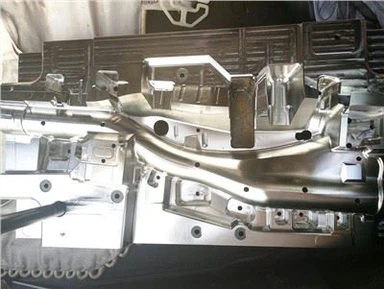
Mucell Molds
MuCell is a thermoplastic foam injection molding process with the aim to reduce weight.
- Fast Delievery
- Quality Assurance
- 24/7 Customer Service
Product Introduction
An Introduction of Mucell
MuCell is a thermoplastic foam injection molding process with the aim to reduce weight.
The process is just a physical manufacturing process requiring no addition of chemical blowing agents to the granulate and dispensing with requirements of decomposition processes to generate blowing gases to foam plastic moldings.
The advantages of this process are:
● Reduced cycle time
● Reduced scrap rate
● Reduced warpage
● Wall thickness optimization design
● Reduced variation cycles
● Reduced consumption of fossil raw materials
● Recyclable
● Reduction of CO2 emissions
● Functionally oriented design
● Enhanced integration of components
Technology
MuCell thermoplastic foam injection molding technology is based on a simple physical principle. During the plasticization process, a good homogenization will be achieved by introducing an inert gas (usually N2 or Co2) into the thermoplastic melt at high pressure. When injected into the mold, the pressure drop directly behind the injection nozzle will lead to the formation of cells. The result will be a monolithic foam - a compact edge layer that solidifies over the foam core - similar to a sandwich structure.
This typically results in a weight savings of at least 8% compared to conventional dense injection molding. Even more weight savings can be achieved through optimized design of components and molds. Reference can also be made here to processes such as negative impression strokes integrated into the mold. The mechanical property changes caused by foaming should be taken into account in the part design.
The expansion of the gas will generate the cavity pressure needed to compensate for shrinkage and, in contrast to standard injection molding, produce parts with good dimensional stability and accuracy with little distortion and pitting. Since outgassing during the injection process can create flow marks on the surface of non-specifically designed and machined parts, these parts require special treatment where they are visible. These effects can be covered by IMD or greatly reduced by, for example, a variable temperature treatment near the surface or a special tool coating.